
When the 2025–2026 FIRST LEGO League season UNEARTHED dropped, a lot of teams had the same first reaction:
“Cool, we’re doing dinosaurs!”
Then someone’s coach gently said, “Actually… that’s paleontology. This season is archaeology.” And the room went quiet.
If your team has been mixing these two up — you are not alone. They both involve digging, dirt, brushes, and people in dusty hats squinting at things. But they’re completely different sciences, and getting the distinction right matters for this season’s Innovation Project. So let’s clear it up once and for all.
A Quick Test
Which of these would a paleontologist study?
- A mammoth tusk frozen in Siberia ✅
- An ancient Roman coin ❌
- The footprint of a dinosaur in rock ✅
- A wooden tool used by a Stone Age human ❌
- A 300-million-year-old fern preserved in coal ✅
- The ruins of a Mayan temple ❌
See the pattern? Paleontology = life forms that existed long before humans, or the natural history of life on Earth. Archaeology = humans and the cultural stuff humans made.
There’s a small overlap — both fields study really old things, and sometimes archaeologists dig up animal bones (because ancient humans hunted and ate animals). But the question they’re trying to answer is different. A paleontologist asks “what was this creature and how did it live?” An archaeologist asks “what does this object tell us about the people who made or used it?”
Why FLL Picked Archaeology, Not Paleontology
This is the part most teams miss, and it’s the most important part for the Innovation Project.
FLL’s whole theme this season is “discovering the past to uncover the future.” Archaeology fits that mission perfectly because archaeology is about people — how they lived, what they built, what problems they solved, and what we can learn from them today.
Paleontology is amazing, but a fossil of a triceratops doesn’t really teach us how to live better lives in 2026. A 4,000-year-old irrigation system from Mesopotamia, on the other hand? That can absolutely teach us about sustainable farming today. A Roman aqueduct can inspire modern water infrastructure. An ancient remedy can lead to new medicine.
That’s the connection FLL wants teams to make. Past humans → present-day innovation.
If your Innovation Project is about dinosaurs, fossils, or extinct species — you’re doing paleontology, and you’re off-theme. Judges will notice.
What Archaeologists Actually Do (And Where the Cool Robot Stuff Comes In)
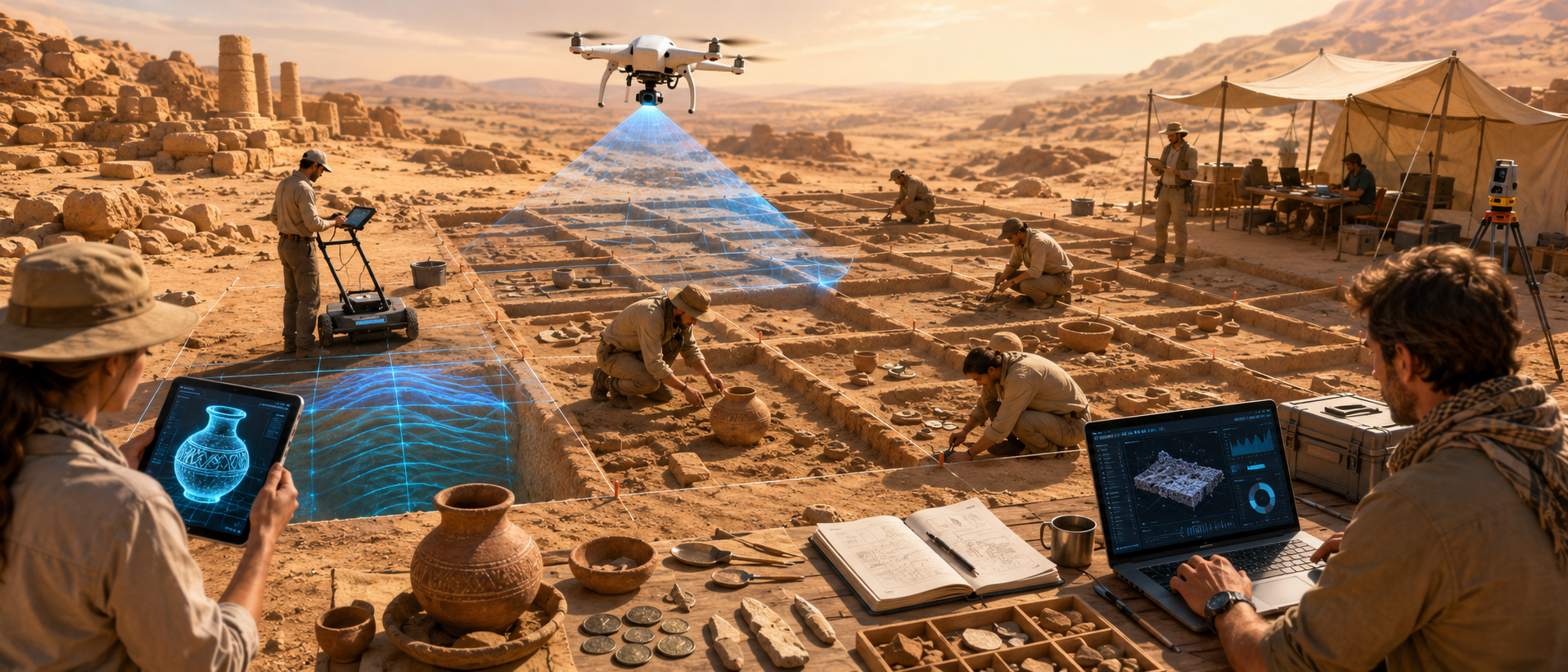
Real archaeology in 2026 isn’t just people kneeling in dirt with toothbrushes (though that still happens). Modern archaeology uses some seriously cool tech:
- Ground-penetrating radar (GPR) — sends radio waves into the ground to “see” buried structures without digging. Like a sonar for dirt.
- LIDAR — lasers mounted on planes or drones that map the ground through tree cover. This is how researchers found entire hidden Mayan cities in the Guatemalan jungle.
- 3D scanning and photogrammetry — building exact digital replicas of artifacts so they can be studied without being touched.
- DNA analysis — extracting genetic information from ancient bones to figure out who people were related to and how they migrated.
- Drones — mapping huge dig sites from above quickly and cheaply.
- AI and machine learning — sorting through millions of artifact images to find patterns humans would miss.
If you’re picking an Innovation Project topic, this is where the gold is. Real archaeologists have real problems — fragile artifacts, slow excavation, unreliable funding, looting, sites destroyed by climate change. A robot, a sensor, an app, or a new tool that helps with any of those problems is a solid Innovation Project direction.
Words Your Team Should Get Right
Since you’re going to be talking about this all season — in front of judges — here are a few terms worth knowing:
- Artifact — an object made or used by humans (a tool, a pot, a coin). NOT a fossil.
- Fossil — the preserved remains of ancient life (bones, shells, plant impressions). NOT an artifact.
- Site — the location of a dig.
- Excavation — the careful, layer-by-layer process of digging.
- Stratigraphy — the study of soil layers. Deeper layer = older stuff (usually).
- Provenance — the exact location and context where an artifact was found. This is huge in archaeology — an artifact without provenance loses most of its scientific value.
- In situ — Latin for “in its original place.” Archaeologists love this phrase.
Sprinkle one or two of these into your judging session and watch the judges’ eyebrows go up.
The Bottom Line
If you remember nothing else:
“Paleontology = life. Archaeology = people. Fossils = paleontology. Artifacts = archaeology. Dinosaurs = paleontology. Pyramids = archaeology. “
This season is about people — what they built, how they solved problems, and what they can still teach us. The cooler your team can get at telling that story, the stronger your Innovation Project (and your judging session) is going to be.
Now go dig in. The right kind of digging.